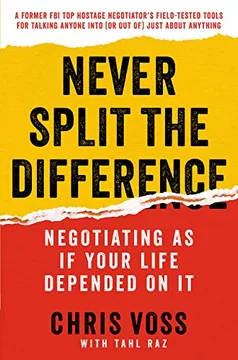
I finished Chris Voss’s book “Never Split the Difference” where he shares his experience and techniques as an FBI hostage negotiator. It surprised me because I thought it would be much more “hardcore” but it’s actually about well-known communication concepts applied to conflict situations.
It’s the kind of book with ideas that seem simple and obvious but are hard to put into practice. The foundation of everything is: people want to feel understood and in control. These aren’t just preferences, they’re deep psychological needs. When someone feels ignored or cornered, their brain goes into defensive mode. The amygdala takes over and things generally get worse.
This explains why so many conversations go wrong. We show up with the solution before understanding what’s really bothering the other person. We defend our position before asking what concerns them. And by doing so, we accidentally trigger the defensive response that makes communication and agreement impossible.
The book talks about mirroring: repeating the last few words of what the other person said.
"I'm not convinced, it feels too forced."
"Too forced?"
"Yes, we work with a different standard"
"A different standard?"
And then shutting up. In that silence the real information appears, the reason behind the reason, what Voss curiously calls the “black swans” of the conversation.
What happens psychologically is that mirroring creates a sense of similarity and safety. The other person feels heard, which lowers their guard. And the silence gives them space to elaborate, to go deeper into what they really mean. Most people never get that space and they appreciate it.
Another thing he explains is labeling. “It seems like this caught you off guard” or “it sounds like you feel your effort wasn’t recognized”. It’s being explicit about showing your counterpart that you notice what’s going on with them. It works because emotions that are named become less intense. When someone puts words to what you’re feeling, the emotional charge decreases. You shift from reacting to observing your own state. And that defuses volatile conversations.
Voss also distinguishes between responses that look like agreement but aren’t. “Yes” is often just to get you to shut up. “You’re right” is usually to end the conversation. A quick yes ends up being a no down the line, which is why he recommends getting three yeses—making sure the conversation is actually complete.
Another thing repeated throughout the book is using calibrated questions, which are ones that can’t be answered with yes or no. For example, if someone asks you to pay more than what you want to pay, instead of saying “no”, you say “That’s too much for me. How I am supposed to pay that?” This avoids confrontation by giving the other person the ability to move toward an agreement. It’s saying “no” in a very controlled way.
Another interesting point: anticipating accusations. Before a difficult conversation, think about the worst things the other person might think about you. And mention them first. “I know this is going to sound like I didn’t plan well…” Naming the elephant in the room makes it easier to deal with. The other person doesn’t have to accuse you of anything because you said it yourself.
This works because it makes confrontation harder. When you verbalize their possible criticisms, you’re demonstrating empathy. It also shows self-awareness, which builds trust. Paradoxically, admitting your weaknesses makes you seem more credible, not less.
The book’s title comes from not splitting the difference. Halfway compromises are usually bad for everyone. If someone wants black shoes and another wants brown, ending up with one of each doesn’t make anyone happy. Better to find out what actually matters to each side.
Of all the ideas, the one I liked most is that conversations need space—mirroring, labeling, etc—to allow enough information to emerge. When you have enough information you have more options to reach an agreement. If you don’t, you can cause unnecessary confrontation.
It’s surprising that “FBI communication” tricks are just communication tricks after all.